
Introduction
Grease baked onto cylinder heads. Carbon in injector bores. Chips and coolant residue packed into blind holes. Hand scrubbing can't reach most of it, and it eats labor hours.
Industrial ultrasonic cleaning tanks attack these soils through immersion and cavitation instead. Parts sit in a heated solution while high-frequency sound reaches surfaces a brush never will.
This guide is for machine shops, repair operations, restoration contractors, and maintenance teams. It covers how cavitation works, where the benefits are real, how to size and specify a tank, and what limits and safety rules apply.
Key Takeaways
- Cavitation, chemistry, and heat work together to reach crevices and blind holes.
- Size a tank around actual part dimensions, batch loads, and soil type.
- Treat frequency, power, temperature, rinsing, and drying as one process.
- Test representative parts before production, and never run flammable solvents in a standard tank.
What Are Industrial Ultrasonic Cleaning Tanks and How Do They Work?
What Is an Industrial Ultrasonic Cleaning Tank?
An industrial ultrasonic cleaning tank is an immersion system that uses high-frequency sound in a liquid solution to remove contaminants from parts, tools, or assemblies.
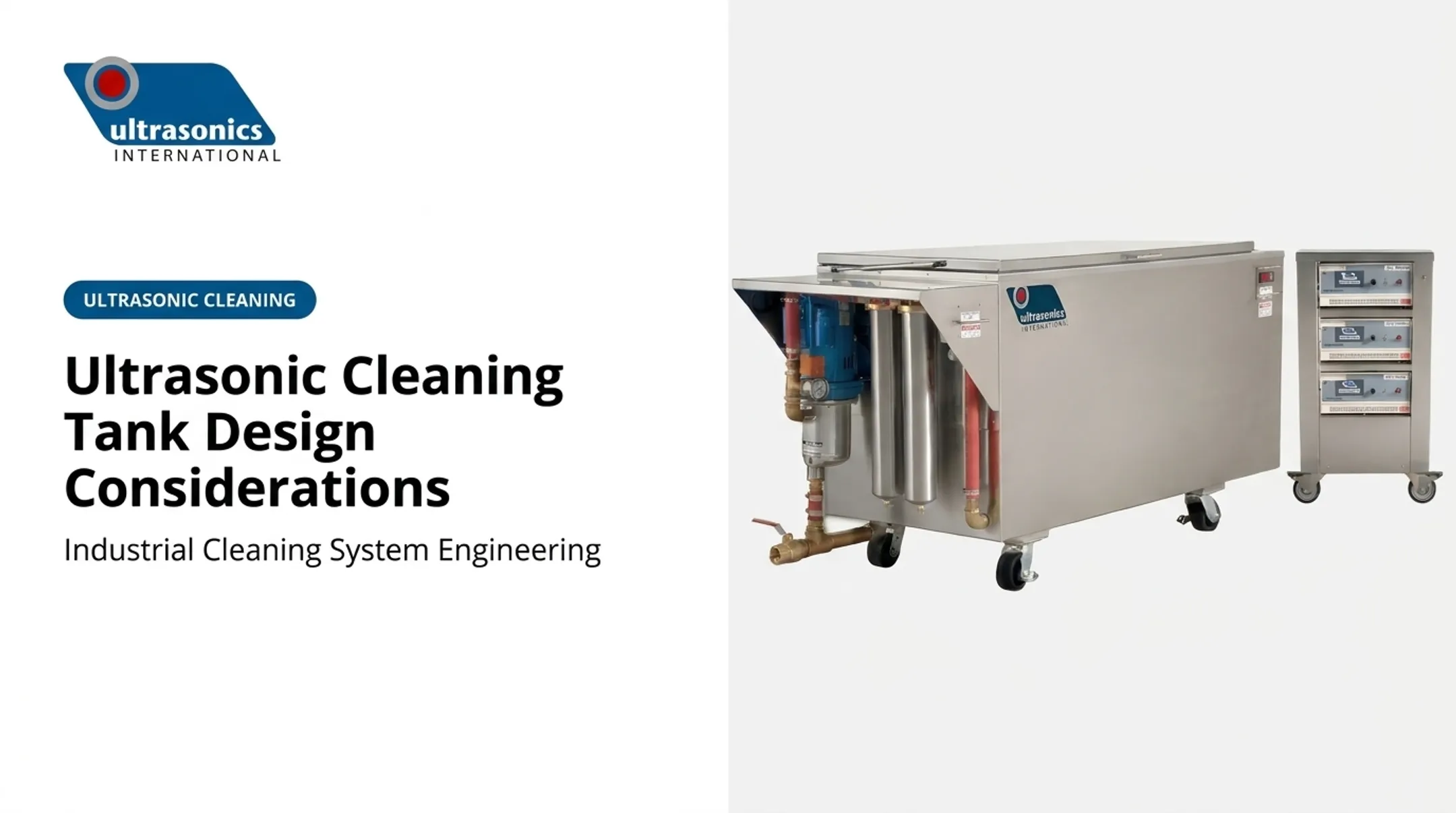
The difference from a consumer unit comes down to duty. Industrial tanks have larger working volumes, heavier construction, baskets or fixtures, and controls built for batch or production work.
Industrial doesn't always mean floor-standing, though. Tovatech's specification guide notes that benchtop units can be industrial too. Continuous-duty rating and build quality are what count.
What Are the Main Components?
- Tank: usually rectangular stainless steel, from 11 to 14 gauge, with heavy-duty tanks at 11 to 12 gauge plus stiffeners
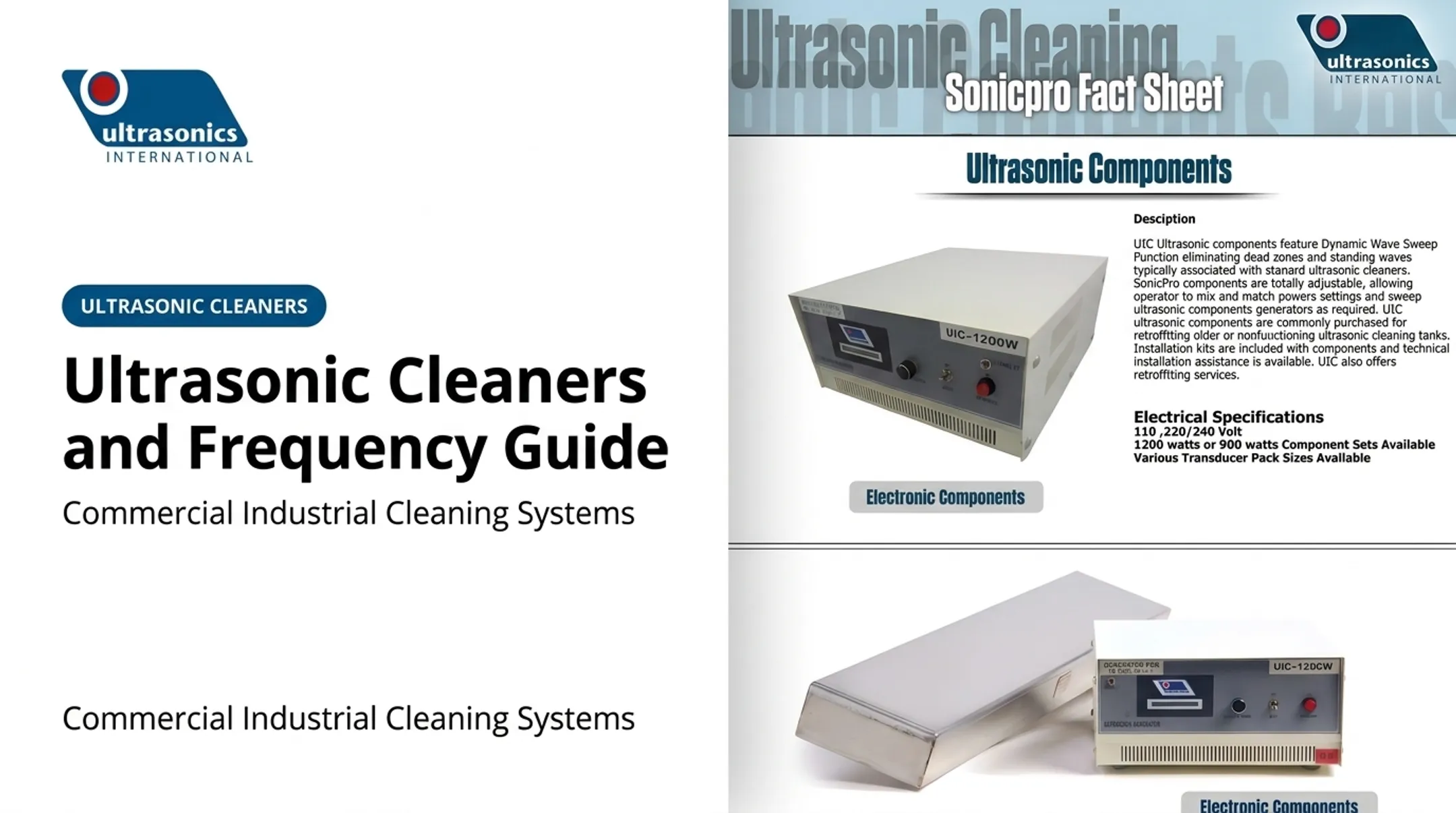
- Generator: supplies the high-frequency electrical signal
- Transducers: convert that signal into mechanical vibration, mounted on the tank bottom or sides, or as immersible packs
- Heater and controls: hold temperature and adjust power
- Baskets or fixtures: keep parts off the tank floor
- Options: filtration, rinse stations, dryers, material handling
How Does Cavitation Remove Contamination?
Sound waves create millions of microscopic bubbles that grow and then implode. Each collapse produces a tiny jet of fluid that loosens soil and pulls fresh solution against the surface.
That's why ultrasonics suits blind holes, threads, grooves, and internal passages. There's no line-of-sight requirement, so geometry that defeats brushes and sprays isn't a problem.
How Do Frequency and Power Affect Cleaning?
No single frequency fits every job:
- Around 25 kHz: larger, more forceful bubbles for caked grease and heavy compounds
- Around 40 kHz: a common industrial balance for general production work
- 80 kHz and above: better for sensitive, precision parts
Power matters just as much as frequency, and it has to reach the whole tank. Poor loading, uneven coverage, or excess energy can cause patchy cleaning or damage. Wave Sweep Technology modulates frequency to reduce standing waves and dead zones.

What Are the Benefits and Industrial Applications of Ultrasonic Cleaning Tanks?
Why Do Manufacturers Use Industrial Ultrasonic Tanks?
Ultrasonic immersion cleans a whole batch at once, reaches difficult geometry, and removes the operator-to-operator variation of hand scrubbing. In practice that means less labor, shorter handling time, faster turnaround, and more predictable inspection or assembly afterward.
Which Industrial Parts and Contaminants Can They Clean?
Typical soils include grease, oil, carbon, coolant residue, chips, flux, rust, soot, and polishing compounds. Chemistry must match the soil.
Representative uses:
- Machine shops: degreasing and chip removal between machining steps
- Automotive and small-engine repair: carburetors, pistons, cylinder heads, injectors
- Marine service: heat exchangers, valves, engine components
- Oil and gas: valve bodies, downhole tools, rigging, and large mechanical parts
- 3D printing: support material and resin removal
- Restoration: smoke- and soot-damaged contents
- Medical and lab: pre-sterilization cleaning of instruments
How Do Ultrasonic Tanks Support Complex or High-Volume Work?
Baskets, fixtures, and part orientation control how much sound and solution each surface sees. Don't stack parts or overload baskets, because that blocks cavitation.
A single heated tank can be enough for light-duty work. Production work usually needs separate stages: pre-wash, ultrasonic wash, rinse, filtration, and drying. A five-station line such as the Fireline Series II from Ultrasonics International combines pre-rinse, pre-wash, ultrasonic cleaning, detail rinse, and high-volume drying.
What Are the Labor and Cost Advantages?
Manual cleaning can tie up several people working one part at a time, with results that depend on technician skill. An ultrasonic tank typically needs one operator and handles multiple parts together.
Customer reports give a sense of scale, though they aren't controlled trials. An Eaton Aerospace case study reports a conservative 20 hours per week saved by replacing manual tube cleaning. Treat that as one customer's result, not a promised benchmark.
When Is Ultrasonic Cleaning a Strong Fit?
It fits best with:
- Intricate parts and internal channels
- Embedded contamination
- Repetitive batch work
- Surfaces that shouldn't be scrubbed hard
- Pre-inspection cleaning that must be repeatable
Validate with representative parts and soils before buying, especially when coatings, tolerances, or cleanliness standards are critical.
How Do You Choose the Right Industrial Ultrasonic Cleaning Tank?
Start With the Parts and Cleaning Requirements
Document the following before talking to any manufacturer:
- Largest and smallest parts, weight, and material
- Geometry, blind holes, internal passages, finishes, and coatings
- Individual or batch cleaning
- Contaminant type and required cleanliness
- Cycle frequency and target throughput
- Floor space, utilities, and rinse or dry needs
Select the Correct Tank Size and Working Capacity
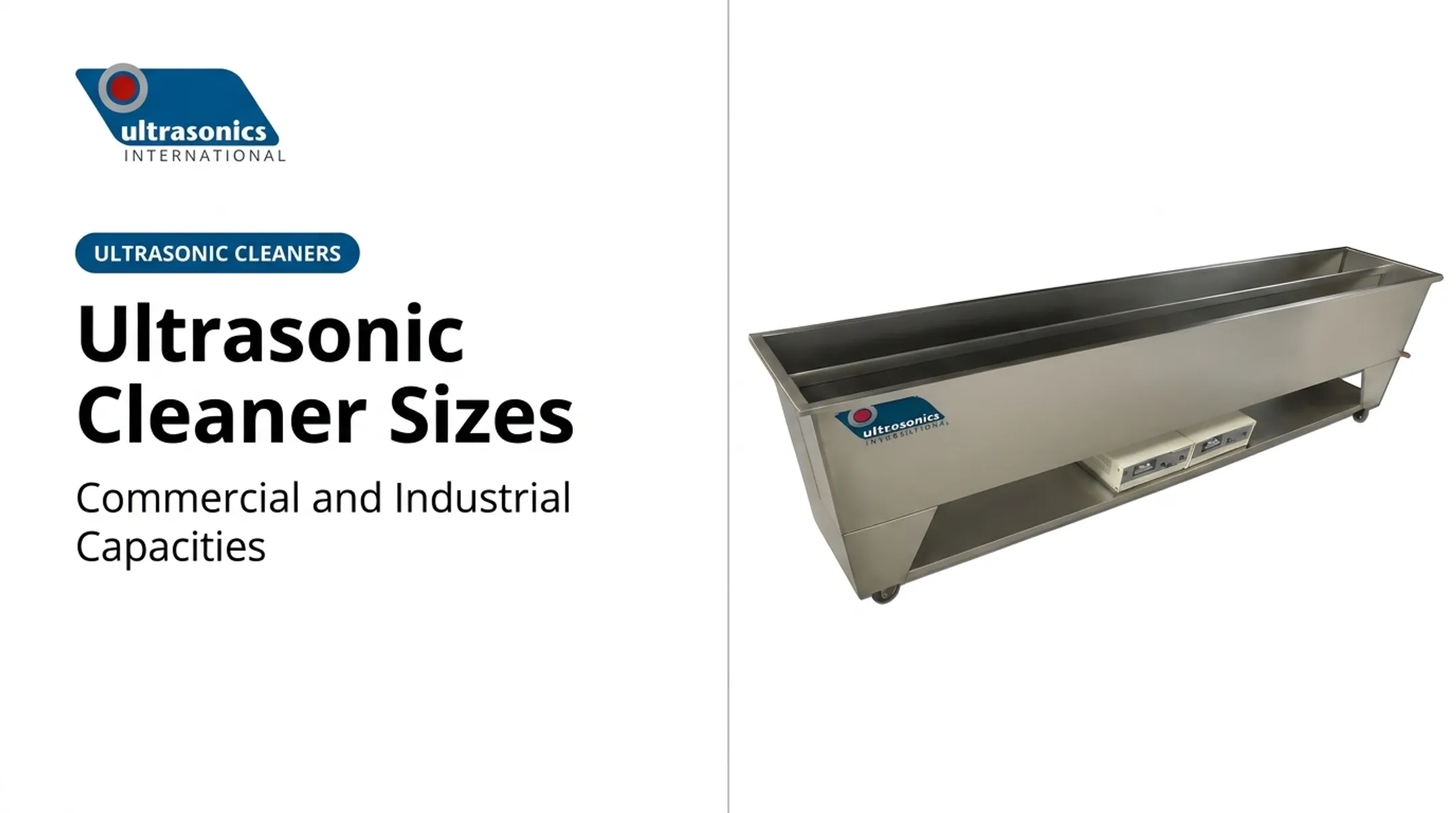
Size by usable working dimensions, not exterior dimensions. Basket, fixture, liquid level, and displacement all shrink the real space. Leave room for circulation and cavitation instead of choosing a tank only because the biggest part fits.
Worked example: a 20 × 12 × 8 in basket fits a 16 × 8 × 6 in part with 4, 4, and 2 in of clearance. At an assumed 13 gal service volume, about 1 gal of displaced solution leaves roughly 12 gal of liquid. Fit alone doesn't prove the load is allowed or that it will clean well.

Sizing checklist:
- Measure the largest part, including handles or protrusions
- Add basket or fixture dimensions
- Confirm submerged depth at the marked liquid level
- Check basket weight limits
- Keep parts from touching each other or the tank
Evaluate Frequency, Ultrasonic Power, and Heating
Balance aggressiveness against surface sensitivity. Power distribution depends on tank geometry, transducer placement, and workload, so a high watt rating alone doesn't guarantee performance. Check whether ratings are effective, peak, or heater watts.
Heat lowers viscosity and improves chemical action. Warm solutions around 120 to 140 °F (50 to 60 °C) are common per Alconox's cleaning guide.
The right temperature still depends on the detergent, material, and soil. Ultrasonic energy also heats the liquid itself.
Choose Chemistry and Process Stages Together
Ultrasonics supplements chemistry. It doesn't replace it. The solution must address the soil, wet the part, cavitate well, and be compatible with the tank and the parts. Water-based detergents are the usual starting point. Foaming guidance varies by product, so follow the supplier's data.
Depending on the soil, add a pre-rinse, ultrasonic rinse, filtration, corrosion protection, or drying. Solvent processes and hazardous locations need separate engineering.
Consider Construction, Controls, and Long-Term Support
Long-term value hinges on build and service details:
- Stainless construction and weld quality
- Access for cleaning and service
- Heaters, lids, drains, and baskets
- Filtration and sound management
- Controls and documentation
Ask about installation help, parts availability, technical support, process testing, warranty, retrofit options, and future expansion.
Ultrasonics International Corp. builds USA-made systems in Ferndale, Washington, along with custom machinery and retrofit solutions. Its equipment uses stainless-steel construction and Wave Sweep Technology, and its manufacturing is overseen by QAI with third-party plant inspections twice a year. Features vary by model, so confirm what a specific system includes.
How Should an Industrial Ultrasonic Tank Be Operated and Maintained?
Prepare the Tank and Solution Before Cleaning
- Fill to the manufacturer's marked level, and never run heaters or ultrasonics dry
- Use approved chemistry
- Filter or replace heavily soiled solution
- Degas fresh solution if the equipment calls for it (about 5 to 10 minutes on some units)
- Verify temperature, concentration, basket condition, and settings
Load Parts Correctly
Suspend parts in a basket or fixture. Contact with transducer surfaces can etch them permanently.
- Avoid overloading and part-to-part contact
- Follow the manual for heavy or sharp items
- Orient cavities, channels, and blind holes so they flood and face the sound
- Keep openings free of trapped air, which blocks cleaning
Establish Inspection and Maintenance Routines
Routine checks should cover:
- Solution condition, tank draining, and sediment removal
- Baskets, sensors, cables, and filters
- Drains, leaks, ultrasonic output, and heaters
Intervals depend on the equipment.
A foil test shows cavitation activity and distribution, but not whether a part is clean. Verify parts with a defined check, such as water-break testing (ASTM F22). Also review U.S. requirements:
- OSHA hazard communication (29 CFR 1910.1200): safety data sheets for each hazardous chemical
- OSHA noise rules: 85 dBA 8-hour average triggers hearing conservation
- Wastewater: 40 CFR 403.5 limits discharges, including below pH 5.0, and local limits apply

What Materials, Parts, and Contaminants Are Suitable for Ultrasonic Cleaning?
Materials Commonly Considered
These materials are commonly cleaned ultrasonically:
- Steel and stainless steel
- Aluminum, brass, and copper
- Ceramics and glass
- Rubber and some plastics
Alloy condition, finish, coatings, seals, and chemistry decide suitability.
Low-frequency energy can damage soft metals such as aluminum and silver, per ASTM G131. Dissimilar metals, plated surfaces, and soft materials may need lower power, shorter cycles, or special chemistry. Prolonged cycles can fatigue elastomers.
Parts Requiring Extra Evaluation
Get a technical review before cleaning:
- Sealed assemblies and electronics
- Porous or bonded components
- Fragile coatings and thin glass
- Parts with trapped air or inaccessible cavities
An aggressive or poorly controlled process can expose defects, push soil deeper into an assembly, or damage a coating.
What Should Not Be Placed in a Standard Industrial Tank?
Keep flammable or volatile solvents out of standard tanks. Heat and ultrasound increase evaporation and can create ignitable mist. Solvent use needs a purpose-built system, plus compliance with manufacturer, electrical, fire, and workplace-safety requirements (OSHA 1910.106 and 1910.307, and NFPA 30).
Ultrasonic cleaning also doesn't sterilize, repair damage, or replace rinsing, drying, inspection, or validation. The CDC notes ultrasound alone doesn't significantly inactivate bacteria, so medical instruments still need terminal processing.
Frequently Asked Questions
Does ultrasonic cleaning really work?
Yes, when the setup fits the job. Cavitation loosens soil from complex surfaces if tank, chemistry, frequency, power, temperature, loading, and cycle time match the application.
What cannot be cleaned in an ultrasonic cleaner?
Soft metals, thin glass, sensitive electronics, fragile coatings, and sealed or porous assemblies can be damaged by cavitation, heat, moisture, or chemistry. Test first and consult the manufacturer.
How do I choose the right industrial ultrasonic cleaning tank?
Start with part dimensions, batch size, soil, material, and throughput. Then evaluate frequency, power, chemistry, heating, rinsing, drying, controls, and available utilities.
What frequency is best for industrial ultrasonic cleaning?
It depends on the soil, part geometry, material sensitivity, and cleaning detail required. Testing with your actual parts is more reliable than picking a frequency in isolation.
What cleaning solution should be used in an ultrasonic tank?
Use a solution formulated for your soil and compatible with the parts and tank. Be cautious with corrosive, flammable, or high-foaming products.
How do you maintain an industrial ultrasonic cleaning tank?
Manage solution quality, keep fill levels correct, clean the tank, and care for baskets. Inspect transducers and heaters, run performance checks, and follow the manufacturer's maintenance instructions.