
Regulations keep tightening around halogenated solvents. EPA documents that TCE is carcinogenic by all exposure routes, and it lists aqueous substitution as one alternative.
But aqueous cleaning is not just "add water." Results depend on chemistry, heat, agitation, concentration, time and the material being cleaned. This guide covers ingredients, mechanisms, cleaner types, aqueous-versus-solvent tradeoffs, ultrasonic use and safe selection.
Key Takeaways
- Aqueous cleaners use water as the main solvent plus surfactants, builders and other additives.
- Soil, substrate, equipment, temperature and drying method decide the right formulation.
- Immersion, spray, manual and ultrasonic methods all work, each with its own controls.
- Water-based does not mean harmless; check the label, SDS and disposal rules.
What Are Aqueous Cleaners and What Are They Made Of?
An aqueous cleaner is a formulation in which water is the primary solvent. Alconox describes it as a blend of ingredients designed to enhance water's cleaning ability, typically a surfactant plus builders. That separates it from plain water and from products that rely mainly on organic solvents.
Water-Based Does Not Mean Water Alone
Water can rinse away loose or water-soluble dirt. It struggles with oils because of its high surface tension. A formulated cleaner improves wetting, soil removal, dispersion, rinsing and metal protection. A "water-based" label tells you little; the full formulation and intended application matter.
Common Ingredients and Their Roles
No single cleaner contains all of these:
- Surfactants lower surface tension so the solution reaches crevices and lifts or emulsifies oils.
- Builders react with calcium, magnesium or iron ions and support alkaline cleaning.
- Chelating agents bind metal ions that interfere with cleaning. EDTA is one example.
- Emulsifiers disperse water-insoluble oils.
- Corrosion inhibitors protect metals during and after cleaning.
- Defoamers keep suds at a low level, which matters in circulating and ultrasonic tanks.
How pH Influences Cleaning
Alkaline cleaners target oils, grease and machining fluids. Acidic cleaners go after rust, mineral deposits and oxides. Near-neutral products suit newly machined parts with water-soluble fluids and sensitive materials.
Compatibility is product-specific. Alconox permits its inhibited formulation on aluminum and zinc with prompt rinsing, and suggests corrosion testing. It also warns against alkaline cleaners on polyurethane and against mixed-metal baths that cause galvanic deposits.
Cleaners vs. Degreasers
A degreaser is formulated to remove oils and grease. An aqueous degreaser is one type of water-based cleaner, not a synonym for all of them.
How Do Aqueous Cleaning Solutions Work?
The solution wets the part, penetrates soil and crevices, and loosens or emulsifies contaminants. Agitation or circulation carries them away. Rinsing and drying follow when required.
The Cleaning Factors That Control Results
Industry often calls this the Sinner's Circle: Jenfab's framework names chemistry, temperature, mechanical action and time. Change one and you usually must adjust another.

A practical example:
- Heat softens greasy deposits, so a cooler bath needs more time.
- Agitation reaches recessed areas that a static soak misses.
- Higher concentration can speed cleaning, but overly concentrated solutions turn abrasive.
How Ultrasonic Cleaning Uses Aqueous Solutions
Ultrasonic tanks send high-frequency sound through the liquid. It forms and collapses microscopic bubbles (cavitation), scrubbing exposed and hidden surfaces, including blind holes and crevices. Cleaning doesn't need line of sight.
Chemistry still matters. The solution must suit both the soil and the part. Some practical notes:
- Common frequencies range from 25 to 100 kHz; lower frequencies suit coarse soils, higher ones fine cleaning.
- Freshly mixed liquid holds air that weakens cavitation, so degas before loading.
- Water cavitates best around 160°F, while caustic solutions clean best near 180°F.
- Ultrasonic energy heats the bath on its own, so monitor temperature.
Rinsing, Drying and Residue Control
Aqueous processes often need one or more rinse stages and controlled drying. Skipped steps leave detergent residue, water spots, flash rust or trapped moisture.
- Use cold rinsing and fast drying on rust-prone steel.
- Use distilled or deionized final rinses where residue limits are tight.
- Rinse stations and parts dryers belong in the workflow, not as afterthoughts.
Why Water Alone May Not Be Enough
Plain water may handle loose or soluble dirt. Heavy oils, carbon, baked-on soils and corrosion products usually need the right chemistry and mechanical action.
Types of Aqueous Cleaners and the Soils They Remove
Aqueous cleaners fall into several chemistry types, each matched to different soils:
| Type | Typical targets |
|---|---|
| Alkaline | Oils, grease, coolants, carbon |
| Acidic | Rust, scale, mineral deposits, oxides |
| Near-neutral | Water-soluble fluids; sensitive materials |
| Low-foam | Spray and circulating systems |
| Corrosion-inhibited | Ferrous and soft metals |
| Specialty | Flux, resin, rosin, carbon |
Strong alkalinity can damage sensitive finishes, so match pH to the substrate. Specialty products handle defluxing, and manufacturers market carbon-removal formulas for ultrasonic tanks. Treat those as manufacturer claims, not comparative studies.
Always verify concentration range, pH, and material compatibility in the technical data sheet and SDS.
Aqueous vs. Solvent Cleaners: Which Is the Better Fit?
Aqueous solutions wet, emulsify, suspend and rinse soils away. Solvents dissolve certain contaminants and then evaporate.
Operational and Environmental Tradeoffs
| Factor | Aqueous | Solvent |
|---|---|---|
| Cleaning action | Wets, emulsifies, rinses | Dissolves, evaporates |
| Post-cleaning | Rinse and dry, often longer | Fast drying |
| Fire risk | Typically low | Varies; some flash points are very low |
| Exposure | Still needs hazard communication | Often higher health risk |
| Waste | Spent bath and wastewater rules apply | Hazardous waste rules apply |
| Material risk | Moisture, corrosion, pH | Seal and plastic attack |
Two cautions. Federal VOC rules exempt some solvents such as acetone, but NIOSH lists its flash point at 0°F, so VOC status is not a fire-safety rating.
Aqueous products don't erase waste duties: under 40 CFR 403.5, sewer discharges can't cause interference, and pH below 5.0 is prohibited unless the treatment works is designed for it.
Real-world results vary. TURI documented a Massachusetts shop that cut aerosol cans by at least 85% after installing an aqueous engine washer, though difficult parts still needed some aerosols.
Boyd's initial aqueous trials left oil on fins and tubes until they changed oils and designed a tilting basket.

When Aqueous May Not Fit
Consider solvent, semi-aqueous or another process when:
- Moisture exposure is unacceptable, as with some electronics.
- Drying time is impractical.
- A hydrophobic residue resists water-based chemistry.
- Part geometry traps liquid.
- A validated process specifies something else.
Decide through testing and documented requirements, not environmental labels.
How to Choose and Use the Right Aqueous Cleaning Solution
Identify the Soil and Cleaning Objective
List the contaminants on the part:
- Grease, oil, carbon, coolant, chips
- Flux, resin, soot, salts
- Rust or scale
Then define the goal: general degreasing, precision cleaning, coating prep, pre-sterilization cleaning, restoration or inspection prep.
Confirm Material Compatibility
Metal, plastic, rubber, coatings, adhesives and electronics each constrain safe pH, temperature and exposure time. Prolonged ultrasonic cycles can fatigue elastomers, and heat can reduce elasticity.
Test on representative parts, especially aluminum, brass, zinc, painted surfaces, seals, electronics and mixed-material assemblies.
Match Chemistry to Method and Workload
Manual, immersion, spray and ultrasonic delivery differ in foam control, circulation, basket design, throughput and drying. Typical applications:
- Repair shops: carburetors, injectors and cylinder heads. Cuda-style washers worked for one auto shop.
- Machine shops: chip and coolant removal between steps. A TURI lab trial (1% Alconox at 100°F, 25-minute heated ultrasonics, DI rinse) reached 97.65% average coolant removal in the lab, not as field throughput.
- Marine service: salt and oxide removal from heat exchangers and raw-water pumps.
- Restoration: precleaning loose soot, then ultrasonics for the remaining soil.
- 3D printing: manufacturers report that 1-2% mild alkaline detergent removes most liquid resins, avoiding flammable IPA baths.
- Medical: The CDC says thorough cleaning must precede disinfection, and ultrasound alone does not significantly inactivate bacteria. Use validated processes.
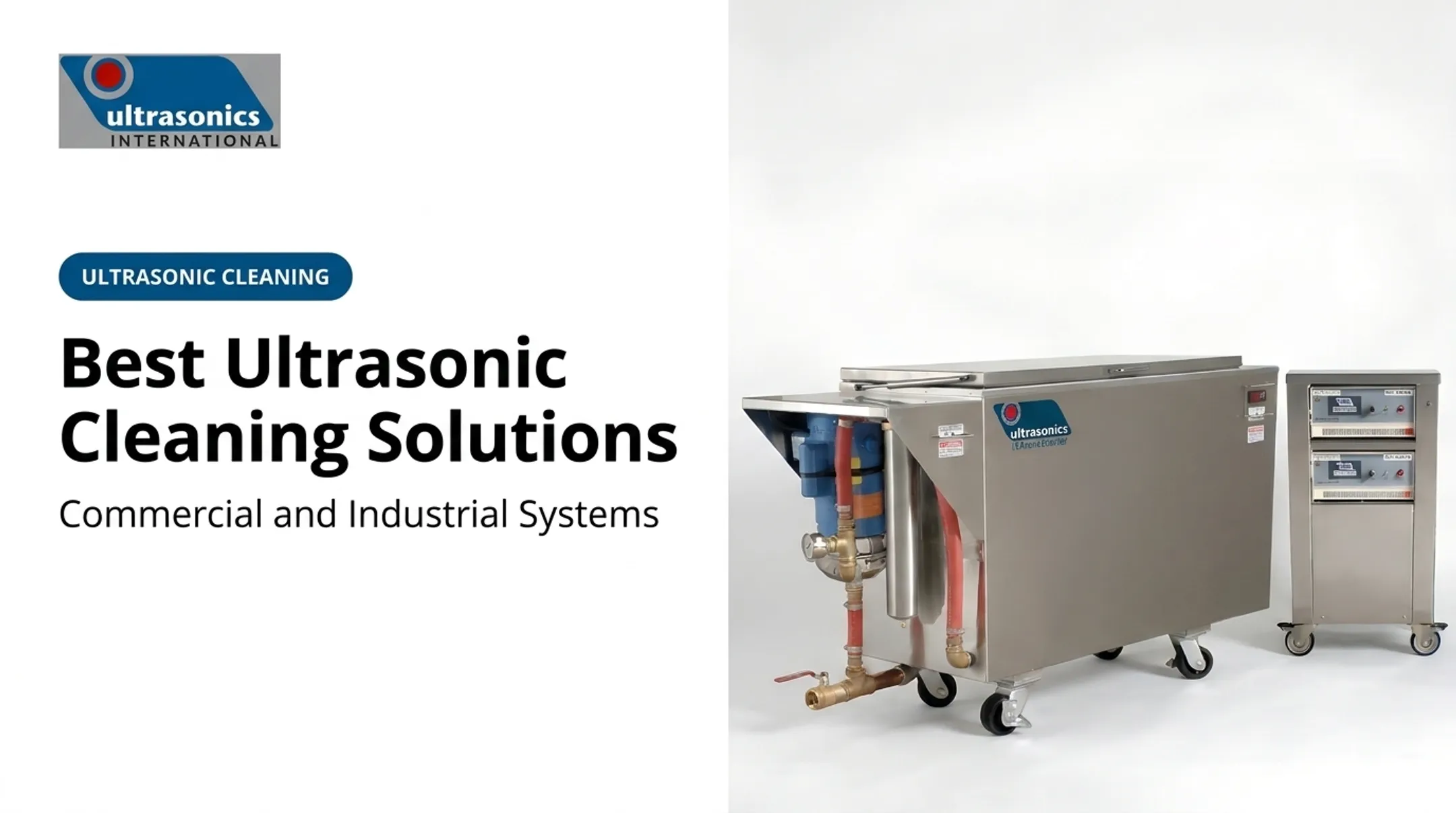
Ultrasonics International Corp. builds USA-made benchtop, heavy-duty, custom and retrofit ultrasonic systems at its Ferndale, Washington plant, for operations that need aqueous chemistry paired with controlled mechanical action. Its range runs from the 25-gallon BT-1400 to the 135-gallon APC4800.

Set and Monitor Process Parameters
Set dilution, bath temperature, cycle time, agitation, rinse and drying from the manufacturer's instructions, then confirm with testing. Record results through:
- Visual inspection
- Water-break testing (ASTM F22), a go/no-go check for hydrophobic films
- Residue or cleanliness testing suited to the application
Manage Safety, Bath Life and Waste
- Review the SDS and label; OSHA requires accessible SDSs and training.
- Use SDS-recommended gloves, goggles or respirators, and ventilate adequately.
- Skim free oil, filter solids and maintain concentration. Replace the bath when performance drops.
- Determine whether spent solution is hazardous waste under 40 CFR 262.11.
Never put flammable liquids or unapproved chemicals directly in an ultrasonic tank. Ultrasound increases vaporization and creates fine mist that can ignite. Follow the equipment manual first.
Frequently Asked Questions
What liquid do you put inside an ultrasonic cleaner?
Typically water with a compatible aqueous detergent chosen for the soil and material. Follow the equipment manual, label and SDS, and never add flammable solvents directly.
Does ultrasonic cleaning really work?
Yes, when cavitation is paired with compatible chemistry. Results depend on frequency, power, temperature, concentration, time, loading and material compatibility.
What is an aqueous cleaner?
A water-based cleaning formulation that may contain surfactants, builders, emulsifiers, chelating agents, pH adjusters and corrosion inhibitors.
What are aqueous cleaners made of?
Water plus selected additives. Ingredients vary with target soil, pH, equipment, substrate, residue limits and safety profile.
What is a surfactant for cleaning?
A surface-active ingredient that lowers water's surface tension so it wets surfaces, penetrates soil, and lifts or emulsifies contaminants.
What is a degreaser?
A cleaner formulated to remove oils and grease. Aqueous degreasers use water as the main medium and need rinsing and drying; solvent degreasers rely on organic solvents.